
CMAJ • February 27, 2007; 176 (5). doi:10.1503/cmaj.061479.
© 2007 Canadian Medical Association or its licensors
All editorial matter in CMAJ represents the opinions of the authors and not necessarily those of the Canadian Medical Association.
This Article
Right arrow Figures Only
Right arrow Full Text (PDF)
Right arrow Submit a response
Right arrow Alert me when this article is cited
Right arrow Alert me when eLetters are posted
Right arrow Alert me if a correction is posted
Services
Right arrow Email this article to a friend
Right arrow Similar articles in this journal
Right arrow Similar articles in PubMed
Right arrow Alert me to new issues of the journal
Right arrow Download to citation manager
Citing Articles
Right arrow Citing Articles via Google Scholar
Google Scholar
Right arrow Articles by Tan, C.-K.
Right arrow Articles by Cheng, K.-C.
Right arrow Search for Related Content
PubMed
Right arrow PubMed Citation
Right arrow Articles by Tan, C.-K.
Right arrow Articles by Cheng, K.-C.
Related Collections
Right arrow Esophagus


Clinical Vistas Briefs

Adult epiglottitis

Che-Kim Tan, Khee-Siang Chan and Kuo-Chen Cheng

Department of Intensive Care Medicine, Chi-Mei Medical Center, Yungkang, Tainan, Taiwan

What's your call?


Figure 14
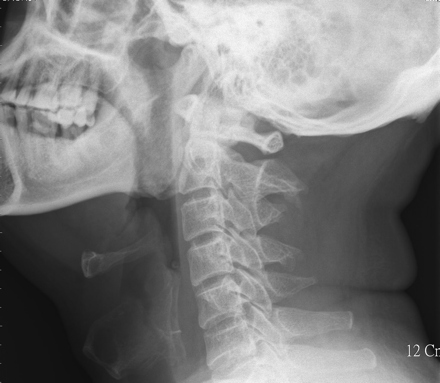
Figure. Soft-tissue radiograph of the neck of a 46-year-old man who presented to the emergency department with a 3-day history of fever, sore throat, dysphagia, odynophagia, drooling and a muffled voice.


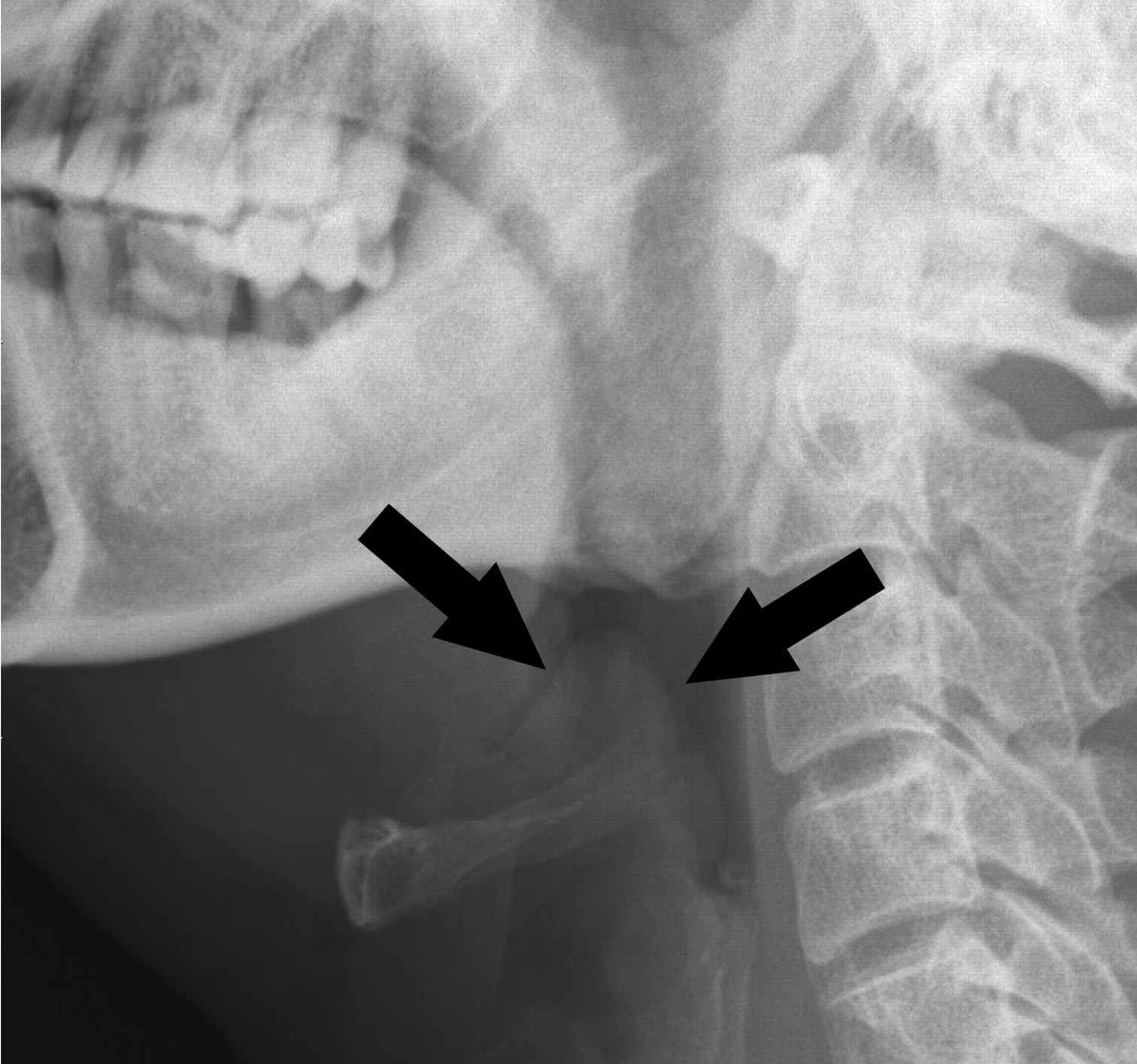
The radiograph showed the classic "thumbprint sign" (Fig. 1, arrows) characteristic of epiglottitis. The patient had progressive respiratory distress and required emergent endotracheal intubation. A swollen epiglottis was seen under direct laryngoscopy. It almost obstructed the airway and allowed only a small-caliber endotracheal tube to pass through. Parenteral therapy with amoxicillin–clavulanate and corticosteroids was begun. The patient recovered well, and the endotracheal tube was removed on day 5, after resolution of the swelling was confirmed with flexible laryngoscopy.
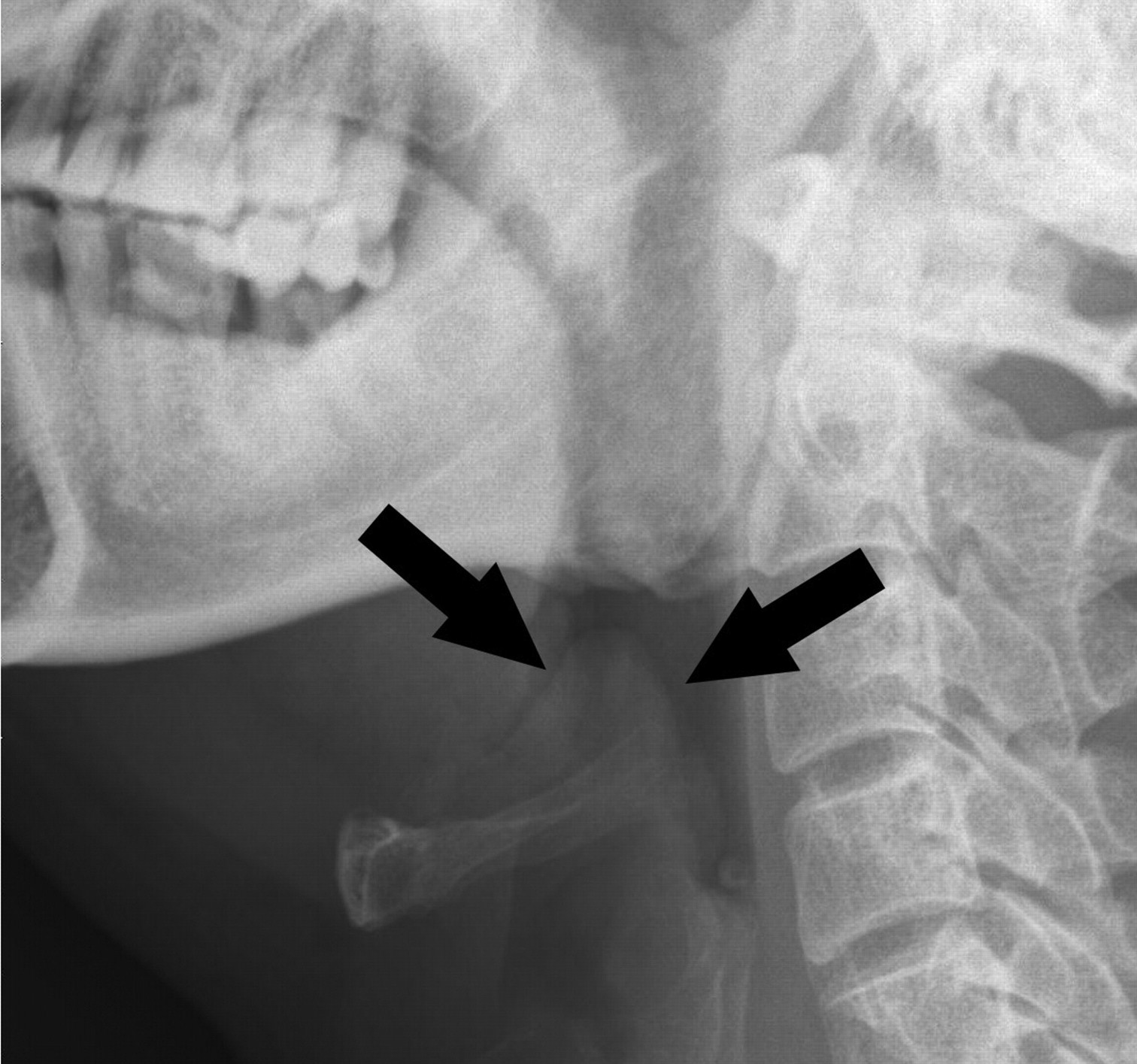

Figure 114
View larger version (148K):
[in this window]
[in a new window]

 
Fig. 1: Classic "thumbprint sign" (arrows) characteristic of epiglottitis.


Before the widespread use of the Haemophilus influenzae type b vaccine, epiglottitis occurred mainly in young children. Recently, the incidence has decreased among children and increased among adults.1 Adult epiglottitis is different from its pediatric counterpart in that organism identification is less common2 and the mortality is higher. From 15% to 21% of patients require either endotracheal intubation or emergent tracheostomy.1,3 The remaining cases can be safely treated with antibiotics. In certain cases intravenous corticosteroid therapy may be of benefit.

The most common symptoms are sore throat, odynophagia and muffled voice.3 Soft-tissue lateral neck radiography has a sensitivity of 88%, whereas laryngoscopy is the most accurate investigation to establish a diagnosis.2 Prompt recognition of the condition and early airway intervention in cases of airway compromise are crucial to avoid a possible fatal outcome.


*    Footnotes
 
Competing interests: None declared.


*    REFERENCES
 Top
 REFERENCES
 

  1. Mayo-Smith MF, Spinale JW, Donskey CJ, et al. Acute epiglottitis. An 18-year experience in Rhode Island. Chest 1995;108:1640-7.
  2. Solomon P, Weisbrod M, Irish JC, et al. Adult epiglottitis: the Toronto Hospital experience. J Otolaryngol 1998;27:332-6.[Medline]
  3. Frantz TD, Rasgon BM, Quesenberry CP Jr. Acute epiglottitis in adults. Analysis of 129 cases. JAMA 1994;272:1358-60.[Abstract/Free Full Text]


This Article
Right arrow Figures Only
Right arrow Full Text (PDF)
Right arrow Submit a response
Right arrow Alert me when this article is cited
Right arrow Alert me when eLetters are posted
Right arrow Alert me if a correction is posted
Services
Right arrow Email this article to a friend
Right arrow Similar articles in this journal
Right arrow Similar articles in PubMed
Right arrow Alert me to new issues of the journal
Right arrow Download to citation manager
Citing Articles
Right arrow Citing Articles via Google Scholar
Google Scholar
Right arrow Articles by Tan, C.-K.
Right arrow Articles by Cheng, K.-C.
Right arrow Search for Related Content
PubMed
Right arrow PubMed Citation
Right arrow Articles by Tan, C.-K.
Right arrow Articles by Cheng, K.-C.
Related Collections
Right arrow Esophagus