
CMAJ • January 20, 2009; 180 (2). doi:10.1503/cmaj.080727.
© 2009 Canadian Medical Association or its licensors
All editorial matter in CMAJ represents the opinions of the authors and not necessarily those of the Canadian Medical Association.
This Article
Right arrow Figures Only
Right arrow Full Text (PDF)
Right arrow Submit a response
Right arrow Alert me when this article is cited
Right arrow Alert me when eLetters are posted
Right arrow Alert me if a correction is posted
Services
Right arrow Email this article to a friend
Right arrow Similar articles in this journal
Right arrow Similar articles in PubMed
Right arrow Alert me to new issues of the journal
Right arrow Download to citation manager
Citing Articles
Right arrow Citing Articles via Google Scholar
Google Scholar
Right arrow Articles by Cescon, D. W.
Right arrow Articles by Juurlink, D. N.
Right arrow Search for Related Content
PubMed
Right arrow PubMed Citation
Right arrow Articles by Cescon, D. W., BSc MD
Right arrow Articles by Juurlink, D. N., MD PhD
Related Collections
Right arrow Poisoning
Right arrowRelated Articles

Discoloration of skin and urine after treatment with hydroxocobalamin for cyanide poisoning

David W. Cescon, BSc MD* and David N. Juurlink, MD PhD*{dagger}

*Department of Medicine, University of Toronto; {dagger}Divisions of General Internal Medicine and of Clinical Pharmacology and Toxicology, Sunnybrook Health Sciences Centre, Toronto, Ont.

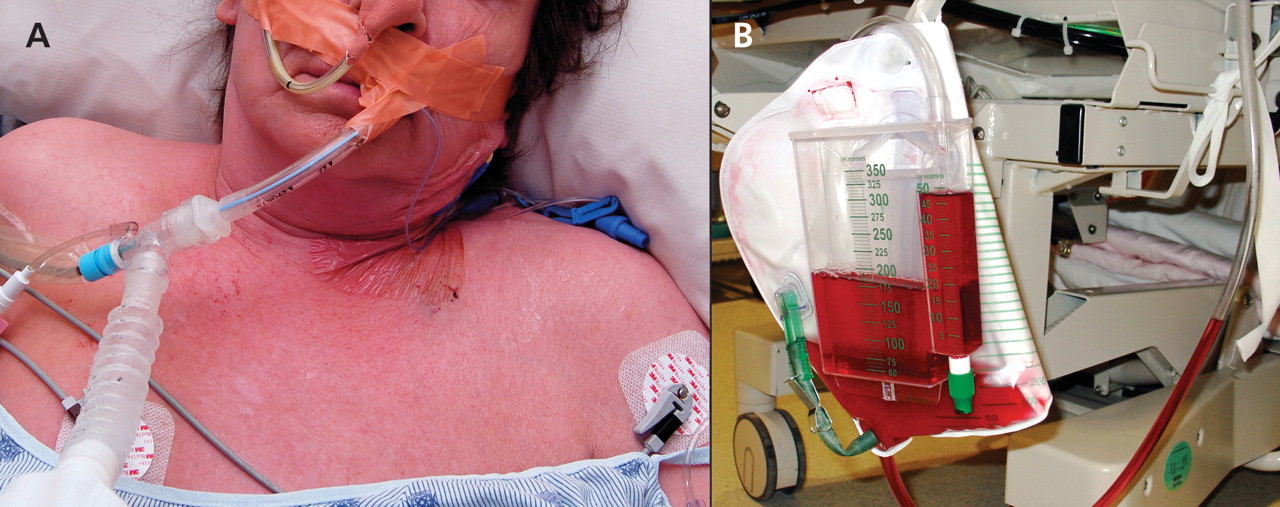
A 54-year-old woman was brought to hospital from an apartment fire. She had altered mental status, hypotension and evidence of inhalational injury, but no burns. Her carboxyhemoglobin level was 29%, and her lactate level was 16 mmol/L. She was treated with supplemental and hyperbaric oxygen for carbon monoxide intoxication. Hydroxocobalamin 5 g was administered intravenously in the intensive care unit for presumed cyanide poisoning. Subsequently, the patient's skin (Figure 1A) and urine (Figure 1B) became bright red.


Figure 127
View larger version (65K):
[in this window]
[in a new window]

 
Figure 1: Photographs showing bright red discoloration of the patient's skin (A) and urine (B) after treatment with hydroxocobalamin for cyanide poisoning.


Cyanide poisoning often occurs in victims of smoke inhalation. Tests that can confirm a diagnosis of cyanide poisoning are rarely available. However, treatment should not be delayed. The diagnosis is clinical and characterized by altered mental status, cardiovascular instability and lactic acidosis. Hydroxocobalamin has been approved recently as a therapy for cyanide poisoning. It is relatively safe and is better tolerated than the ingredients of the traditional cyanide antidote kit (amyl nitrite, sodium nitrite and sodium thiosulfate). The nitrites induce methemoglobinemia, which can worsen hypotension and reduce the oxygen content of the blood, an important consideration in patients with concomitant carbon monoxide poisoning. Hydroxocobalamin should be administered as soon as cyanide poisoning is suspected — ideally in the prehospital setting.1 By combining with cyanide, hydroxocobalamin forms cyanocobalamin (vitamin B12), restoring mitochondrial function.2 Hydroxocobalamin imparts a harmless and transient reddish colour to the skin and urine. It may also cause transient hypertension, which can be beneficial in patients with cyanide poisoning.1

Footnotes

Clinical images are chosen because they are particularly intriguing, classic or dramatic. Submissions of clear, appropriately labelled high-resolution images must be accompanied by a figure caption and the patient's written consent for publication. A brief explanation (300 words maximum) of the educational significance of the images with minimal references is required.


REFERENCES

  1. Borron SW, Baud FJ, Barriot P, et al. Prospective study of hydroxocobalamin for acute cyanide poisoning in smoke inhalation. Ann Emerg Med 2007;49:794-801, 801.e1-2. [CrossRef][Medline]
  2. Shepherd G, Velez LI. Role of hydroxocobalamin in acute cyanide poisoning. Ann Pharmacother 2008;42:661-9.[Abstract/Free Full Text]

Related Articles

Highlights
Can. Med. Assoc. J. 2009 180: 145. [Full Text] [PDF]

Dans ce numéro
Can. Med. Assoc. J. 2009 180: 147. [Full Text] [PDF]


This Article
Right arrow Figures Only
Right arrow Full Text (PDF)
Right arrow Submit a response
Right arrow Alert me when this article is cited
Right arrow Alert me when eLetters are posted
Right arrow Alert me if a correction is posted
Services
Right arrow Email this article to a friend
Right arrow Similar articles in this journal
Right arrow Similar articles in PubMed
Right arrow Alert me to new issues of the journal
Right arrow Download to citation manager
Citing Articles
Right arrow Citing Articles via Google Scholar
Google Scholar
Right arrow Articles by Cescon, D. W.
Right arrow Articles by Juurlink, D. N.
Right arrow Search for Related Content
PubMed
Right arrow PubMed Citation
Right arrow Articles by Cescon, D. W., BSc MD
Right arrow Articles by Juurlink, D. N., MD PhD
Related Collections
Right arrow Poisoning
Right arrowRelated Articles