


Background and epidemiology: Streptococcus pyogenes is a ubiquitous bacterial organism that gives rise to a wide variety of cutaneous and systemic infections (Fig. 1). It is an important cause of acute pharyngitis and can lead to the development of scarlet fever and nonsuppurative sequelae such as rheumatic heart disease and glomerularnephritis.1 S. pyogenes primarily comes to the attention of public health officials when it manifests as invasive group A streptococci (GAS) infection. This occurs when GAS are isolated either from a normally sterile site or from a nonsterile site and there is evidence of clinical severity: toxic shock syndrome, necrotizing fasciitis (“flesh-eating disease”) or meningitis.

Fig. 1: Strep throat, caused by group A Streptococcus (GAS). Note the inflammation of the oropharynx and petechiae. GAS bacteria are spread through direct contact with mucus from the nose or throat of persons who are infected, or through contact with infected sores or skin wounds. Photo by: CDC/Heinz F. Eichenwald
In 2000, Health Canada added invasive GAS infection to the list of reportable diseases. The estimated incidence of these infections for that year was 1.95/100 000 — still relatively rare, although the incidence appeared to be increasing.
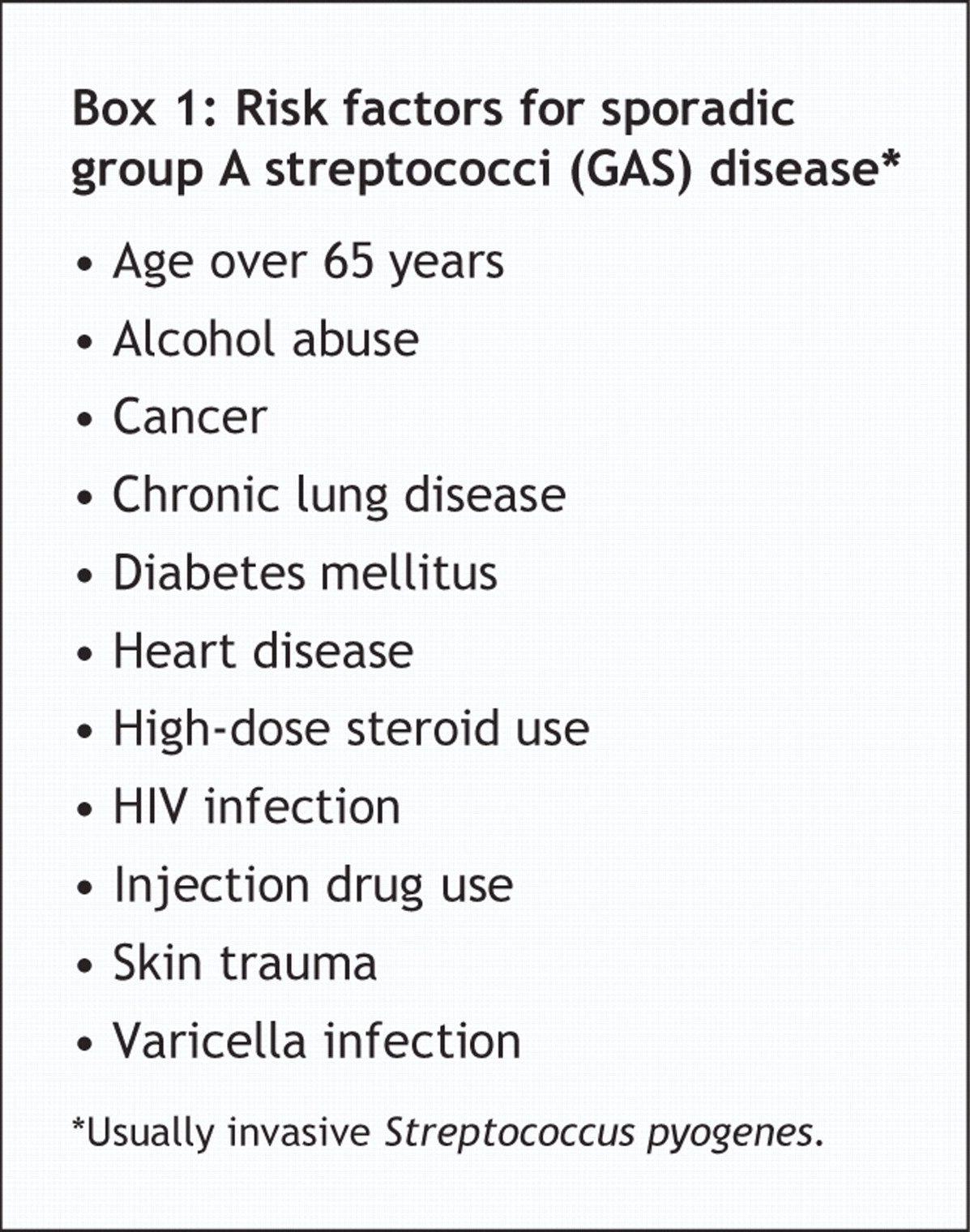
Susceptibility to invasive GAS infection appears to depend on a combination of agent and host factors (Box 1). The bacteria produces a number of exotoxins and proteins, including M protein, an important virulence determinant. Strains rich in M protein are resistant to phagocytosis, multiply rapidly in human blood and are capable of initiating disease. GAS may be divided into serotypes according to antigenic differences in the M protein and, more recently, into genotypes on the basis of nucleotide differences in the emm gene encoding the molecule. More than 150 different M-protein gene sequences types (emm types) have been documented, rendering the emm type an important surveillance tool in investigations of the dynamics of GAS disease.2

Clinical management: Necrotizing fasciitis is an infection of the subcutaneous tissues and fascia characterized by extensive and rapidly spreading necrosis. It may start innocently and should be suspected when the patient's pain is out of proportion to the clinical findings. The area of cellulitis often progresses rapidly and may look necrotic. Management requires prompt recognition, surgical débridement, high-dose intravenous penicillin, and clindamycin to reduce toxin (protein) synthesis by the organism.1
Toxic shock syndrome is diagnosed when hypotension coexists with signs of 2 or more of adult respiratory distress syndrome, coagulopathy, liver dysfunction, a generalized maculopapular rash, renal impairment and soft-tissue necrosis. Treatment amounts to penicillin, clindamycin and immune globulin (all delivered intravenously) with intensive supportive care.1
Prevention: No vaccine currently exists that will prevent GAS infections. Patients admitted to hospital should undergo droplet precautions for the first 24 hours of antibiotic therapy.
Although such patients' close contacts are conventionally administered prophylactic antibiotics, a recent review of evidence3 suggests that this convention may be based more on tradition than evidence. We recommend instead that prophylaxis be administered to contacts with risk factors for sporadic disease (Box 1) and their household members. Patient contacts without risk factors should, instead of receiving antibiotics automatically, be educated about the clinical manifestations of GAS infections and maintain a heightened index of suspicion for 30 days after the diagnosis of the index case.
Oral penicillin is the prophylactic antibiotic of choice. Azithromycin is indicated for patients who are allergic to penicillin, provided that the bacterial strain isolated in the index case demonstrates susceptibility to it.3


Article tools


Jump to section
Related Articles
Cited By...
- No citing articles found.
More in this TOC Section
Similar Articles
Collections