
CMAJ • June 21, 2005; 172 (13). First published June 1, 2005; doi:10.1503/cmaj.050640
© 2005 CMA Media Inc. or its licensors
All editorial matter in CMAJ represents the opinions of the authors and not necessarily those of the Canadian Medical Association.
This Article
Right arrow Figures Only
Right arrow Full Text (PDF)
Right arrow All Versions of this Article:
cmaj.050640v1
172/13/1684    most recent
Right arrow Submit a response
Right arrow Alert me when this article is cited
Right arrow Alert me when eLetters are posted
Right arrow Alert me if a correction is posted
Services
Right arrow Email this article to a friend
Right arrow Similar articles in this journal
Right arrow Similar articles in PubMed
Right arrow Alert me to new issues of the journal
Right arrow Download to citation manager
Citing Articles
Right arrow Citing Articles via HighWire
Right arrow Citing Articles via Google Scholar
Google Scholar
Right arrow Articles by Wooltorton, E.
Right arrow Search for Related Content
PubMed
Right arrow PubMed Citation
Right arrow Articles by Wooltorton, E.
Related Collections
Right arrow Dentistry & Oral Medicine
Right arrow Adverse drug reactions


PRACTICE

SYNOPSIS

Health and Drug Alerts

Patients receiving intravenous bisphosphonates should avoid invasive dental procedures

Eric Wooltorton

CMAJ

Reason for posting: The intravenous bisphosphonates pamidronate (Aredia) and zoledronic acid (Zometa) are often used to treat cancer-related hypercalcemia, Paget's disease and symptoms from solid-tumour bone metastases and osteolytic lesions of multiple myeloma. However, since 2003, osteonecrosis of the jaw has been reported in at least 217 patients taking the drugs,1 often soon after procedures such as tooth extraction.2 In light of this, the US Food and Drug Administration recently sent a letter to health care professionals warning that patients taking these drugs should avoid invasive dental procedures.2

The drugs: Bisphosphonates work by inhibiting osteoclast-mediated bone resorption. They are often prescribed for use over long periods and in conjuction with chemotherapeutic agents or steroids.

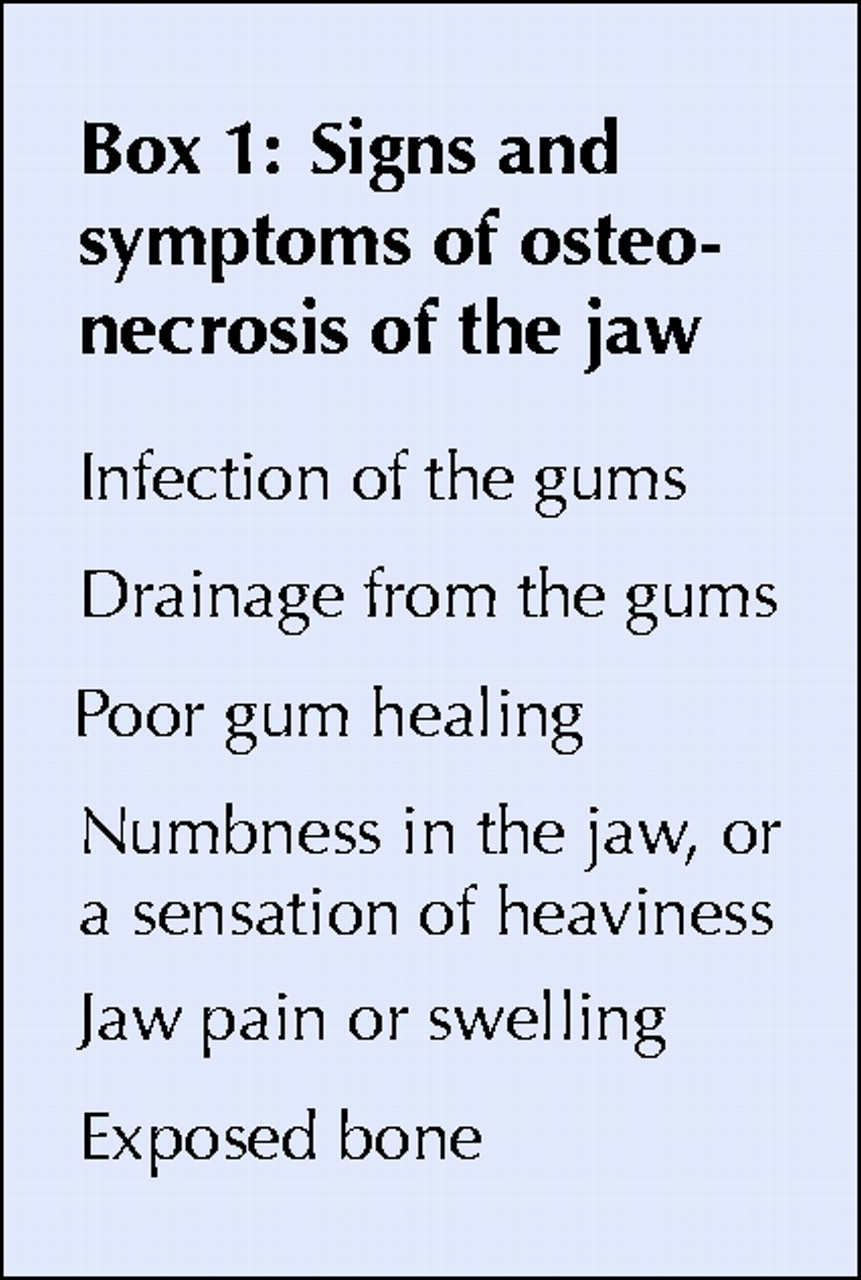
It is unclear why the osteonecrosis (avascular necrosis) experienced seems to affect the jaw preferentially. It occurs, often after many months of using the drugs,3 in 1 patient in about 10 000.1 Possible risk factors include having a diagnosis of cancer; using corticosteroids, chemotherapy or radiation therapy; and having a comorbid condition, including poor oral hygiene, dental disease and infection (including osteomyelitis), anemia and coagulopathies.2 Although some affected patients notice no symptoms, others experience more serious signs and symptoms (see Box). Osteonecrosis of the jaw is rarely reported in patients who take bisphosphonates orally, including long-term users.3


View larger version (53K):
[in this window]
[in a new window]
 
Box 1.


What to do: Patients who are to receive intravenous bisphosphonates should be warned of this potential effect. If time permits before the drug therapy is initiated, a dental examination may detect and allow treatment of tooth or gum problems that could predispose a patient to osteonecrosis. Proper denture fit should be ensured and good dental hygiene reinforced. The oral hard and soft tissues of patients taking these drugs should be examined every 3 months or so. Invasive procedures that may require bone to heal, such as tooth extractions and bone biopsies, should be avoided if possible. When dental surgery is required, it is uncertain whether cessation of bisphosphonate therapy decreases the risk of necrosis. Prompt referral to a dentist or oral maxillofacial surgeon is recommended for patients with facial symptoms of osteonecrosis, although surgery in the affected area may exacerbate or prolong the condition. Conservative management includes culturing any lesions and using antibiotics as appropriate, and recommending an antiseptic oral rinse that contains chlorhexidine gluconate. Unfortunately, some affected patients ultimately require the resection of portions of their jaw.

Footnotes

Published at www.cmaj.ca on June 1, 2005.


References

  1. Novartis Pharmaceuticals Co. Updated safety: possible relationship of Aredia (pamidronate disodium) and/or Zometa (zoledronic acid) with osteonecrosis of the jaw [letter to health care professionals]. Ottawa: Health Canada; Nov 2004. Available: www.hc-sc.gc.ca/hpfb-dgpsa/tpd-dpt/aredia_zometa_hpc_e.html (accessed 2005 May 26).
  2. Novartis Pharmaceuticals Co. Important drug precaution for dental health professionals with patients being treated for cancer [letter to dentists]. Rockville (MD): US Food and Drug Administration; 2005 May 5. Available: www.fda.gov/medwatch/safety/2005/safety05.htm#zometa2 (accessed 2005 May 26).
  3. Ruggiero SL, Mehrotra B, Rosenberg TJ, Engroff SL. Osteonecrosis of the jaws associated with the use of bisphosphonates: a review of 63 cases. J Oral Maxillofac Surg 2004;62:527-34.[CrossRef][Medline]


This article has been cited by other articles:


Home page
Am J Health Syst PharmHome page
S. N. Gebara and H. Moubayed
Risk of osteonecrosis of the jaw in cancer patients taking bisphosphonates
Am. J. Health Syst. Pharm., September 1, 2009; 66(17): 1541 - 1547.
[Abstract] [Full Text] [PDF]


This Article
Right arrow Figures Only
Right arrow Full Text (PDF)
Right arrow All Versions of this Article:
cmaj.050640v1
172/13/1684    most recent
Right arrow Submit a response
Right arrow Alert me when this article is cited
Right arrow Alert me when eLetters are posted
Right arrow Alert me if a correction is posted
Services
Right arrow Email this article to a friend
Right arrow Similar articles in this journal
Right arrow Similar articles in PubMed
Right arrow Alert me to new issues of the journal
Right arrow Download to citation manager
Citing Articles
Right arrow Citing Articles via HighWire
Right arrow Citing Articles via Google Scholar
Google Scholar
Right arrow Articles by Wooltorton, E.
Right arrow Search for Related Content
PubMed
Right arrow PubMed Citation
Right arrow Articles by Wooltorton, E.
Related Collections
Right arrow Dentistry & Oral Medicine
Right arrow Adverse drug reactions