


- © 2005 CMA Media Inc. or its licensors
Abstract
Background: Thrombolysis for acute ischemic stroke has remained controversial. The Canadian Alteplase for Stroke Effectiveness Study, a national prospective cohort study, was conducted to assess the effectiveness of alteplase therapy for ischemic stroke in actual practice.
Methods: The study was mandated by the federal government as a condition of licensure of alteplase for the treatment of stroke in Canada. A registry was established to collect data over 2.5 years for stroke patients receiving such treatment from Feb. 17, 1999, through June 30, 2001. All centres capable of administering thrombolysis therapy according to Canadian guidelines were eligible to submit patient data to the registry. Data collection was prospective, and follow-up was completed at 90 days after stroke. Copies of head CT scans obtained at baseline and at 24–48 hours after the start of treatment were submitted to a central panel for review.
Results: A total of 1135 patients were enrolled at 60 centres in all major hospitals across Canada. The registry collected data for an estimated 84% of all treated ischemic stroke patients in the country. An excellent clinical outcome was observed in 37% of the patients. Symptomatic intracranial hemorrhage occurred in only 4.6% of the patients (95% confidence interval [CI] 3.4%–6.0%); however, 75% of these patients died in hospital. An additional 1.3% (95% CI 0.7%–2.2%) of patients had hemiorolingual angioedema.
Conclusions: The outcomes of stroke patients undergoing thrombolysis in Canada are commensurate with the results of clinical trials. The rate of symptomatic intracranial hemorrhage was low. Stroke thrombolysis is a safe and effective therapy in actual practice.
Thrombolytic therapy for stroke was first reported in 19581 and a subsequent small trial was reported in 19632 in the absence of brain parenchymal imaging but guided by angiography. The later arrival of CT scanning was an enabling technological event, and early dose-finding trials were begun in the 1980s,3,4,5 with large randomized trials conducted a decade later. Results of randomized trials of streptokinase therapy for ischemic stroke were uniformly negative.6,7,8 Results of trials of tissue plasminogen activator (tPA) were mixed in their respective primary analyses9,10,11,12,13 but overall showed a benefit that wanes as time from symptom to treatment elapses.14,15 A meta-analysis of randomized controlled trials showed that 55 fewer patients per 1000 treated with tPA within 6 hours after stroke would be dead or dependent at the end of follow-up compared with patients given placebo.16 Nevertheless, use of thrombolysis for stroke remains controversial, particularly because it is unclear whether such a therapy that is dependent on time, technology and infrastructure can be broadly and safely applied.
In Canada, tPA therapy for stroke was conditionally licensed in 1999. As a condition of approval, a prospective registry to monitor safety was mandated by the federal government. The Canadian Alteplase for Stroke Effectiveness Study (CASES) was launched to collect data on outcomes for all patients treated with tPA in Canada. The purposes of the study were (a) to assess the safety of alteplase for stroke in the context of routine care and (b) to assess whether efficacy demonstrated in randomized clinical trials could be translated into effectiveness in clinical practice.
Methods
CASES was a prospective observational cohort study.17 All patients given intravenous alteplase therapy for acute ischemic stroke in Canada from Feb. 17, 1999, through June 30, 2001, were eligible to be included. Centres were initially recruited from the membership of the Canadian Stroke Consortium. Subsequently, any hospital that was able to provide thrombolytic treatment according to Canadian guidelines18 was eligible to participate. Information on patient demographic characteristics, baseline stroke severity and treatment was collected. All centres were required to perform a baseline CT scan and another scan within 24–48 hours after thrombolytic therapy to look for intracranial hemorrhage.
Outcome events were collected and rated using the modified Rankin Scale (mRS), which measures functional dependence on a scale of 0 (no symptoms) to 6 (death), and the National Institutes of Health Stroke Scale (NIHSS), which quantifies the neurologic examination. The primary outcome was excellent functional outcome (mRS score 0–1) compared with disability or death (mRS score 2–6). Secondary binary outcomes included independence (mRS score 0–2) and complete neurologic recovery (NIHSS score 0–1). Missing outcome data were imputed using the principle of carrying the last score forward. Safety outcomes were symptomatic intracranial hemorrhage, any intracranial hemorrhage, serious systemic hemorrhage and angioedema. Symptomatic intracranial hemorrhage was defined as any clinical decline in neurologic status in the first 24 hours after thrombolytic treatment that occurred between the baseline CT scan showing no hemorrhage and a follow-up CT scan showing new hemorrhage consistent with the new or worsening clinical symptoms and signs. Asymptomatic intracranial hemorrhage was defined as any hemorrhage on follow-up brain imaging that was not associated with a decline in neurologic status. A serious systemic hemorrhage was defined as a bleeding episode other than intracranial hemorrhage that was considered life-threatening by the investigator or resulted in a drop in hemoglobin concentration of 50 g/L or more or required 2 or more units of packed red blood cell transfusion. Orolingual angioedema was defined as localized swelling of the tongue, lips or oropharynx within 6 hours after the start of alteplase infusion.19 Any other serious adverse event was defined as one that was life-threatening, permanently disabling or sufficiently incapacitating such that the patient required a prolonged stay in hospital or required prescription drug therapy. All definitions were provided to study centres in a protocol binder. All outcome events were judged by the local investigator, who was not blinded to clinical history.
Each centre was asked to submit copies of baseline and follow-up CT scans for central review by a panel comprised of stroke neurologists and a neuroradiologist (members of the panel are included in online Appendix 1 at www.cmaj.ca/cgi/content/full/172/10/1307/DC1). The panel rated each baseline and follow-up scan using the ASPECTS (Alberta Stroke Program Early CT Score);20,21 the median score was used as a consensus score. In addition, the panel evaluated each baseline and follow-up scan using the ECASS (European Cooperative Acute Stroke Study) classification to determine the type of hemorrhagic infarction (type 1 or 2) and parenchymal hematoma (type 1 or 2).
Midway through the study (June 2000), a phone and mail survey of all hospitals with CT scanners in Canada was conducted. The hospital pharmacy, head of emergency medicine, head of medicine, head of intensive care and head of neurology and neurosciences were surveyed to determine whether any stroke patients had been treated with tPA but had not been reported to CASES.
Each centre obtained institutional ethical approval for the data collection protocol. The design, management, data collection and analysis of the study were independently funded by a partnership between the Canadian Stroke Consortium, the Canadian Stroke Network and the Heart and Stroke Foundation of Canada. The study was cosponsored by Hoffmann–La Roche Canada Ltd., which commissioned the study, helped with infrastructure by supporting regional educational initiatives and paid investigators an honorarium of $100 per patient.
Data are reported in frequency tables using standard descriptive statistics. Comparison of proportions and 95% confidence intervals (CIs) for proportions were calculated using Fisher's exact test. Multivariable adjustment was made using logistic regression derived from a backwards elimination model. All variables included in the model were statistically significant at p < 0.05. Development of the expected outcome for the cohort was derived from an equation representing the published logistic regression model from the results of the National Institute of Neurological Disorders and Stroke (NINDS) rt-PA Stroke Study22 (Dr. Barbara Tilley, Chair, Department of Biostatistics, Bioinformatics and Epidemiology, Medical University of South Carolina: personal communication, 2002). The relation between ASPECTS score and outcome was modelled from a logistic regression equation, with adjustment for age and baseline NIHSS score.
Results
Data were collected over 2.5 years for a total of 1135 stroke patients at 60 participating centres in Canada. Case reporting was complete and sequential for centres enrolled in the study, as reported by the local investigators. Patients given thrombolysis but not reported to CASES were managed at centres not enrolled in the study. Patients were given alteplase intravenously at 0.9 mg/kg body weight according to standard guidelines18 and based on estimated weight. Seventeen patients (1.5%) received additional treatment with intra-arterial alteplase adjuvant therapy, and 151 (13.3%) were enrolled in clinical trials. Of the 151 patients, 146 were in trials of adjuvant neuroprotective therapy (see online Appendix 2 at www.cmaj.ca/cgi/content/full/172/10/1307/DC1), all of which were ultimately neutral in their respective final analyses. The remaining 5 patients in clinical trials were enrolled in the Interventional Management of Stroke Study23 and therefore received a smaller amount of alteplase intravenously (0.6 mg/kg body weight) followed by up to 22 mg of additional alteplase intra-arterially.
Clinical follow-up was complete for all 1135 patients within 24 hours after thrombolysis treatment. Complete 90-day follow-up was available for 987 (87.0%); the final outcome measure (mRS score) for the remaining 148 patients was imputed from the hospital discharge outcome. Twenty-five patients (2.2%) were lost to all clinical follow-up after 24 hours after treatment; 2 of these patients were known to have had symptomatic intracranial hemorrhage and were presumed to have died in hospital. Therefore, final outcomes were available for 1110 patients. The baseline characteristics are shown in Table 1.
Table 1.
Stroke severity was high, with a median NIHSS score of 14 (interquartile range [IQR] 9–19). This degree of severity is identical to that in the NINDS rt-PA Stroke Study but more severe than that in the 3 other tPA stroke trials. The median age of the patients was 73 (IQR 63–80) years, slightly more men than women were treated, and a large majority of patients were white. A total of 96 (8.5%) patients experienced stroke as inpatients. A minority of patients (14.9%) had an estimated mRS score greater than 2 before stroke, which indicated pre-existing functional disability.

Fig. 1: Baseline ASPECTS (Alberta Stroke Program Early CT Score) as predictor of an excellent outcome (functional independence) in patients experiencing an acute ischemic stroke. A higher baseline score is associated with a greater probability of an excellent outcome. Data are based on a fitted logistic regression model that adjusted for baseline NIHSS (National Institutes of Health Stroke Scale) score, age and baseline serum glucose level. The curve was generated from point-wise confidence intervals (CIs); the screened area represents 95% CIs.
Among the 936 (82.5%) baseline CT scans available for review, the median ASPECTS score was 8 (IQR 6–9). Only 21.5% of the scans had an ASPECTS score of 10, which indicated that a large majority of patients had evidence of early ischemic change on the baseline CT scan. Of the 895 (78.9%) follow-up CT scans available for review, 28.9% showed any degree of intracranial hemorrhage. Among the patients with clinically symptomatic intracranial hemorrhage (4.6%), most (83.8%) of the hemorrhages were classified as parenchymal hematoma according to the ECASS classification.25 The baseline ASPECTS score was not a predictor of symptomatic intracranial hemorrhage, but it was a strong predictor of outcome, with lower scores implying a lower probability of an independent functional outcome (odds ratio [OR] 0.81, 95% CI 0.75–0.87, per 1-point decrement in the ASPECTS score) (Fig. 1).
Table 2.
The median time from stroke onset to treatment was 155 (IQR 130–175) minutes. The median door-to-treatment time was 85 (IQR 60–109.5) minutes. Protocol violations occurred in 154 (13.6%) patients (Table 2). More patients with protocol violations than patients treated according to guidelines had symptomatic intracranial hemorrhage (7.8% v. 3.9%; relative risk [RR] 2.0, 95% CI 1.1– 3.8). However, protocol violations were not associated with an increased risk of dependence or death at final follow-up (RR 1.1, 95% CI 0.9–1.3).
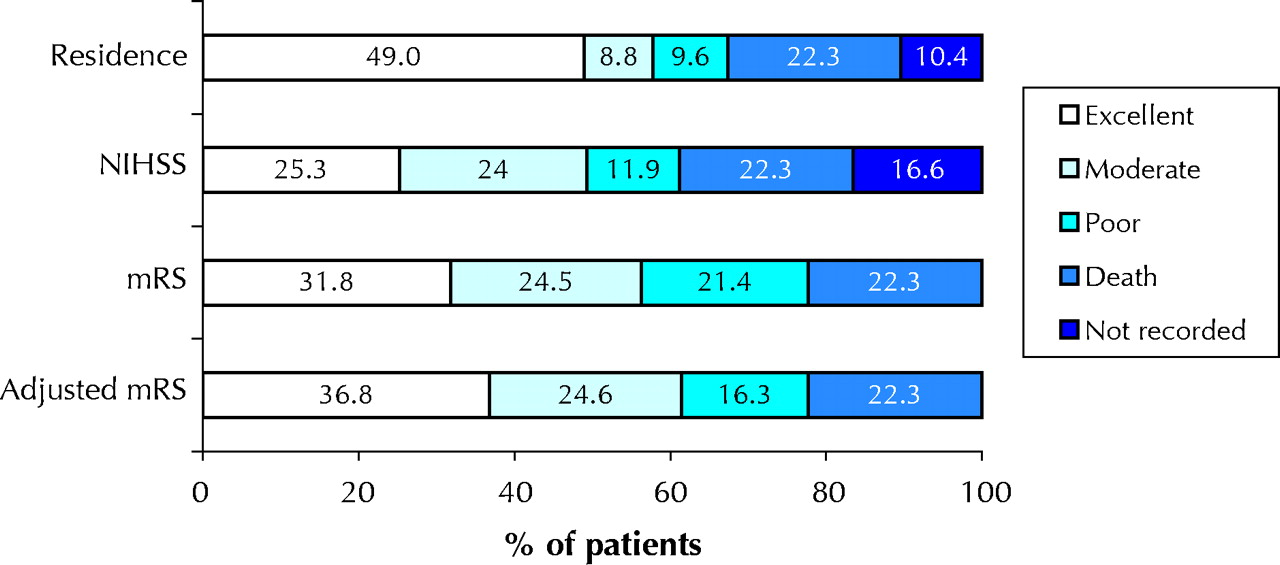
Fig. 2: Patient outcomes at 90-day follow-up. Excellent = modified Rankin Scale (mRS) score of 0–1, National Institutes of Health Stroke Scale (NIHSS) score of 0–1 and discharged home; moderate = mRS score 2–3, NIHSS score of 2–8, transferred to rehabilitation facility; poor = mRS score of 4–5, NIHSS score of > 8, transferred to nursing home. Residence refers to where the patient was living at the 90-day follow-up. Adjusted mRS implies difference between mRS score at 90-day follow-up and mRS score before stroke. This adjustment provides a composite measure of patients who achieved either an excellent functional outcome or returned to their baseline level of function, or both. For example, a patient with a baseline mRS score of 3 who had a score of 3 at 90 days would be rated in the “excellent outcome” category.
Clinical outcomes are shown in Fig. 2. The overall 90-day mortality was 22.3% (95% CI 20.0%–25.0%). The observed rate of an excellent outcome was not significantly lower than the expected rate derived from the NINDS rt-PA Stroke Study results22 (36.8% and 39.9% respectively; p = 0.15, Fig. 3), and was similar to rates in other reported series.26,27,28,29,30,31,32,33,34,35,36

Fig. 3: Observed versus expected outcomes among CASES patients. Excellent = mRS score of 0–1, NIHSS score of 0–1, discharged home; other = mRS score of 2–6, NIHSS score of 2–42, transferred to rehabilitation facility; e(mRS) = expected outcome, derived using regression equations from the National Institute of Neurological Disorders and Stroke rt-PA Stroke Study.22
Serious adverse events occurred in 75 (6.6%) of the patients (95% CI 5.2%–8.2%) (Table 3). Of the 52 (4.6%) who had a symptomatic intracranial hemorrhage, 39 (75%) died in hospital. The total 90-day mortality after symptomatic intracranial hemorrhage was 79% (95% CI 65%– 89%), for a rate of fatal intracranial hemorrhage in the study population of 3.6% (95% CI 2.6%–4.9%). Only 1 patient with symptomatic hemorrhage recovered to a level of functional independence. One patient underwent a neurosurgical procedure for symptomatic intracerebral hemorrhage but died 3 days later. In a multivariable analysis, only an elevated serum glucose level before treatment (OR 1.6, 95% CI 1.2–2.3 per 5-mmol/L increase in baseline serum glucose level) and an increased time from stroke onset to treatment (OR 1.2, 95% CI 1.0–1.5 per 30-minute increase in onset-to-treatment time) were independent predictors of symptomatic intracranial hemorrhage.
Table 3.
Orolingual angioedema37 occurred in 15 patients (1.3%, 95% CI 0.7%–2.2%) and was managed medically in all but 2 patients, who required emergent management of the airway (intubation in 1 and cricothyroidotomy in the other; both patients survived). Serious systemic hemorrhage occurred in 4 patients (0.4%): at the site of femoral artery puncture (for angiography) in 3 and from the oropharynx in 1. Acute hypotension occurred during alteplase infusion in 4 patients (0.4%); in each case cardiac disease was ruled out, and the patients responded to volume expansion with crystalloid or colloid infusion, and dobutamine in 1 patient.
Of the 60 participating centres, 10 were high-volume centres (1 or more patients treated per month) and accounted for 61% of the patients. There were 33 community hospitals and 27 tertiary care hospitals; all of the high-volume centres were tertiary care hospitals. No differences in the rates of excellent outcome or symptomatic intracranial hemorrhage were observed between the high-volume and low-volume centres or between the tertiary care hospitals and the community hospitals. Multivariable adjustment did not modify this observation.
As expected, octogenarians were less likely than younger patients to have an excellent outcome (RR 0.65, 95% CI 0.52– 0.80).38 However, age of 80 years or greater was not a risk factor for symptomatic intracranial hemorrhage (RR 0.96, 95% CI 0.5– 1.8). Blood pressure was lowered acutely before thrombolysis in 8.9% of patients, and this was associated with a reduced chance of an excellent outcome (RR 0.7, 95% CI 0.5– 0.97). After adjustment for baseline NIHSS score, age, baseline serum glucose level and baseline ASPECTS score, a trend to poorer outcome persisted among patients whose blood pressure was lowered. Lowering of blood pressure did not protect against, nor increase the risk of, symptomatic intracranial hemorrhage.
In June 2000, an estimated 224 hospitals had active CT scanners,39 of which 80 were registered with the study. Of the 144 nonregistered sites, we surveyed 139 and received responses from 107 (77% response rate). We were informed at that time that an additional estimated 80 patients had been treated (including those treated with intra-arterial thrombolysis) but had not been reported to the CASES registry. We estimate that CASES accounted for 84% of the alteplase-treated stroke patients in Canada. Using census data, the estimated number treated and an age-adjusted rate of ischemic stroke of 117.6 per 100 000 population,40 we determined that only 1.4% of 90 200 patients with ischemic stroke received thrombolysis during the study period.
Interpretation
CASES captured the first 2.5 years of open-label alteplase use for acute ischemic stroke in Canada, providing a framework for the development of acute stroke protocols across the country. A return to a pre-stroke level of functioning was seen in 36.8% of the patients. This observed outcome compares favourably with the expected outcome derived using results from NINDS rt-PA Stroke Study. It is important to note that the CASES patients represent patients receiving a treatment in actual practice and not a selected clinical trial population. Our results give substantial credence to the generalizability of the results of the NINDS rt-PA Stroke Study13 and pooled results from meta-analyses.15,16,41
The rate of symptomatic intracranial hemorrhage was lower than that seen in major trials of thrombolysis. This may reflect differences in the types of patients treated. Alternatively, unblinded assessment of outcomes may have resulted in underestimation of the true rate. Finally, it is possible that our reported rate underestimates the Canadian national rate because sites not reporting their results to CASES may have been more likely to have treated patients who experienced adverse events. Notably, only 1 patient was referred for neurosurgical intervention after symptomatic intracranial hemorrhage, and this patient did not survive. This low rate of referral may represent a belief that nothing further could be done for such patients42 and is consistent with the lack of current surgical evidence suggesting benefit of craniotomy for spontaneous intracerebral hemorrhage. Three-quarters of the symptomatic hemorrhages were fatal, a rate higher than that observed in the NINDS rt-PA Stroke Study. However, given that the rate of symptomatic intracranial hemorrhage was lower in CASES than in the NINDS trial, the 2 trials had a similar 90-day mortality from intracranial hemorrhage.
The observation that orolingual angioedema, an uncommon but potentially serious adverse event, was more frequent among CASES patients (1.3%) than among patients receiving thrombolysis for myocardial infarction (0.02%)43 is an important feature of this treatment surveillance study. The mechanisms of orolingual angioedema may be related to angiotensin-converting-enzyme inhibitors and the location of the infarction.37
Canadian neurologists were half as likely as those in previous case series to break protocol;44 nevertheless, protocol violation was an important predictor of symptomatic intracranial hemorrhage.
The CASES results should be interpreted with recognition of the study's limitations. Case ascertainment was not complete, and therefore selection bias may have influenced the results. Also, Canada's health care system, with its centralized infrastructure, allows the natural development of stroke centres; therefore, generalizability to other jurisdictions may not follow.
The average time from stroke onset to treatment was 2.5 hours, and the average door-to-treatment time was well over the 1-hour target set by the NINDS in 1997.45 The estimated proportion of the stroke population treated was less than 2%, similar to the proportion in the United States.46 These treatment rates are low despite good access to basic technology such as CT scanning in both countries.47 The CASES data supplement the clinical trial data and argue for more widespread development of infrastructure and training of stroke physicians to deliver thrombolytic therapy to people experiencing acute ischemic stroke.
Footnotes
-
A set of PowerPoint slides that summarizes the methods and results of the Canadian Alteplase for Stroke Effectiveness Study (CASES) is available online for teaching or study purposes (www.cmaj.ca/cgi/content/full/172/10/1307/DC2).
This article has been peer reviewed.
Contributors: The study was coordinated at the University of Calgary. Michael Hill and Alastair Buchan managed the study and developed the data collection templates. Michael Hill conducted the statistical analysis. He also drafted the first version of the manuscript, and the entire CASES Writing Committee developed the ideas and analyses, and reviewed and edited the final manuscript.
Acknowledgement: The CASES investigators would like to acknowledge the many hours worked by Zeenie Ramji in coordinating the day-to-day workings of the study.
The study was funded cooperatively by the Canadian Stroke Consortium, the Canadian Stroke Network and Hoffmann–La Roche Canada Ltd. Alastair Buchan was funded in part by the Alberta Heritage Foundation for Medical Research and the Heart and Stroke Foundation of Alberta, NWT & Nunavut. Michael Hill was funded in part by the Heart and Stroke Foundation of Alberta, NWT & Nunavut, the Canadian Institutes for Health Research and the Alberta Heritage Foundation for Medical Research.
Competing interests: Michael Hill and Alastair Buchan received honoraria from Hoffmann–La Roche Canada Ltd. for speaking at CME events.
References
In this issue



Article tools


Jump to section
Related Articles
Cited By...
- Tenecteplase 0.4 mg/kg in moderate and severe acute ischemic stroke: A pooled analysis of NOR-TEST & NOR-TEST 2A
- Differential Contribution of ASPECTS Regions to Clinical Outcome after Thrombectomy for Acute Ischemic Stroke
- Correlation between ASPECTS and Core Volume on CT Perfusion: Impact of Time since Stroke Onset and Presence of Large-Vessel Occlusion
- Region-specific agreement in ASPECTS estimation between neuroradiologists and e-ASPECTS software
- Use of MRI to predict symptomatic haemorrhagic transformation after thrombolysis for cerebral ischaemia
- Pediatric ASPECTS predicts outcomes following acute symptomatic neonatal arterial stroke
- Clinical Utility of Electronic Alberta Stroke Program Early Computed Tomography Score Software in the ENCHANTED Trial Database
- Long-term stroke prevention: We can do better
- Proportion of single-chain recombinant tissue plasminogen activator and outcome after stroke
- Good Intracranial Collaterals Trump Poor ASPECTS (Alberta Stroke Program Early CT Score) for Intravenous Thrombolysis in Anterior Circulation Acute Ischemic Stroke
- Orolingual Angioedema During or After Thrombolysis for Cerebral Ischemia
- Scientific Rationale for the Inclusion and Exclusion Criteria for Intravenous Alteplase in Acute Ischemic Stroke: A Statement for Healthcare Professionals From the American Heart Association/American Stroke Association
- Is more really better?: The effect of enrollment volume on outcomes for medical therapies
- Incidence, predictors and clinical characteristics of orolingual angio-oedema complicating thrombolysis with tissue plasminogen activator for ischaemic stroke
- Elevated pretreatment blood pressure and IV thrombolysis in stroke
- Endovascular treatment of tandem vascular occlusions in acute ischemic stroke
- The quality of treatment of hyperacute ischemic stroke in Canada: a retrospective chart audit
- Alberta Stroke Program Early Computed Tomography Score to Select Patients for Endovascular Treatment: Interventional Management of Stroke (IMS)-III Trial
- Stroke thrombolysis: where are we and where are we going?
- Do risks outweigh benefits in thrombolysis for stroke?
- A Case-Controlled Comparison of Thrombolysis Outcomes Between Wake-Up and Known Time of Onset Ischemic Stroke Patients
- Guidelines for the Early Management of Patients With Acute Ischemic Stroke: A Guideline for Healthcare Professionals From the American Heart Association/American Stroke Association
- Reperfusion Therapy in Unclear-Onset Stroke Based on MRI Evaluation (RESTORE): A Prospective Multicenter Study
- Airway management in a patient with severe angioedema after thrombolysis for ischemic stroke
- Predicting the Risk of Symptomatic Intracerebral Hemorrhage in Ischemic Stroke Treated With Intravenous Alteplase: Safe Implementation of Treatments in Stroke (SITS) Symptomatic Intracerebral Hemorrhage Risk Score
- Does the Application of X-Ray Contrast Agents Impair the Clinical Effect of Intravenous Recombinant Tissue-Type Plasminogen Activator in Acute Ischemic Stroke Patients?
- Impact of Thrombolysis on Stroke Outcome at 12 Months in a Population: The Bern Stroke Project
- Stroke Epidemiology, Patterns of Management, and Outcomes in Fortaleza, Brazil: A Hospital-Based Multicenter Prospective Study
- Patient outcomes from symptomatic intracerebral hemorrhage after stroke thrombolysis
- Thrombolysis With 0.6 mg/kg Intravenous Alteplase for Acute Ischemic Stroke in Routine Clinical Practice: The Japan post-Marketing Alteplase Registration Study (J-MARS)
- Attitudes and Beliefs of Michigan Emergency Physicians Toward Tissue Plasminogen Activator Use in Stroke: Baseline Survey Results From the INcreasing Stroke Treatment through INteractive behavioral Change Tactic (INSTINCT) Trial Hospitals
- Outcomes of Thrombolysis for Acute Ischemic Stroke in Octogenarians Versus Nonagenarians
- The "Golden Hour" and Acute Brain Ischemia: Presenting Features and Lytic Therapy in >30 000 Patients Arriving Within 60 Minutes of Stroke Onset
- Set up and run a thrombolysis service for acute stroke
- Outcomes of Thrombolytic Therapy for Acute Ischemic Stroke in Chinese Patients: The Taiwan Thrombolytic Therapy for Acute Ischemic Stroke (TTT-AIS) Study
- Medication Errors in Acute Cardiovascular and Stroke Patients: A Scientific Statement From the American Heart Association
- A Citywide Prehospital Protocol Increases Access to Stroke Thrombolysis in Toronto
- Pre-Tissue Plasminogen Activator Blood Pressure Levels and Risk of Symptomatic Intracerebral Hemorrhage
- Routine Use of Intravenous Low-Dose Recombinant Tissue Plasminogen Activator in Japanese Patients: General Outcomes and Prognostic Factors From the SAMURAI Register
- Factors Associated With Intracerebral Hemorrhage After Thrombolytic Therapy for Ischemic Stroke: Pooled Analysis of Placebo Data From the Stroke-Acute Ischemic NXY Treatment (SAINT) I and SAINT II Trials
- Review of current and emerging therapies in acute ischemic stroke
- Admission Hyperglycemia Predicts a Worse Outcome in Stroke Patients Treated With Intravenous Thrombolysis
- Thrombolysis for ischaemic stroke and glioblastoma multiforme: a case report
- Thrombolytic therapy with alteplase for ischaemic stroke
- Impact of the Approval of Intravenous Recombinant Tissue Plasminogen Activator Therapy on the Processes of Acute Stroke Management in Japan: The Stroke Unit Multicenter Observational (SUMO) Study
- The gender effect in stroke thrombolysis: Of CASES, controls, and treatment-effect modification
- Haemorrhagic transformation in acute ischaemic stroke following thrombolysis therapy: classification, pathogenesis and risk factors
- Is It Time to Definitely Abandon Neuroprotection in Acute Ischemic Stroke?
- MRI-Based and CT-Based Thrombolytic Therapy in Acute Stroke Within and Beyond Established Time Windows: An Analysis of 1210 Patients
- Risk Factors of Symptomatic Intracerebral Hemorrhage After tPA Therapy for Acute Stroke
- Thrombolytic therapy for acute ischaemic stroke in octogenarians: selection by magnetic resonance imaging improves safety but does not improve outcome
- Estimated Cost Savings of Increased Use of Intravenous Tissue Plasminogen Activator for Acute Ischemic Stroke in Canada
- Leukoaraiosis and intracerebral hemorrhage after thrombolysis in acute stroke
- Site of Arterial Occlusion Identified by Transcranial Doppler Predicts the Response to Intravenous Thrombolysis for Stroke
- Differential Prognosis of Isolated Cortical Swelling and Hypoattenuation on CT in Acute Stroke
- Asymptomatic Hemorrhage After Thrombolysis May Not Be Benign: Prognosis by Hemorrhage Type in the Canadian Alteplase for Stroke Effectiveness Study Registry
- Translational vehicles for neuroprotection
- An Expedited Code Stroke Protocol Is Feasible and Safe
- Acute stroke treatment: the end of the first decade
- How well does ASPECTS predict the outcome of acute stroke treated with IV tPA?
- Comparison of Tissue Plasminogen Activator Administration Management Between Telestroke Network Hospitals and Academic Stroke Centers: The Telemedical Pilot Project for Integrative Stroke Care in Bavaria/Germany
- Insular cortical ischaemia does not independently predict acute hypertension or hyperglycaemia within 3 h of onset
- Thrombolysis in patients older than 80 years with acute ischaemic stroke: Canadian Alteplase for Stroke Effectiveness Study
- Referral Bias May Underestimate Number of Very Elderly Patients Eligible for rtPA
- Is old age really a reason to withhold thrombolytic therapy?
- Factors Associated With In-Hospital Mortality After Administration of Thrombolysis in Acute Ischemic Stroke Patients: An Analysis of the Nationwide Inpatient Sample 1999 to 2002
- Part 9: Adult Stroke
- Gender Differences in tPA-Related Arterial Recanalization * Response:
- Diagnostic Biomarkers for Stroke: A Stroke Neurologist's Perspective
- MRI Screening Before Standard Tissue Plasminogen Activator Therapy Is Feasible and Safe
- More Evidence in Support of Thrombolysis for Acute Stroke
- Minerva
- Research suggests thrombolysis is effective for acute ischaemic stroke
More in this TOC Section
Similar Articles