

This Article
Right arrow Full Text (PDF)
Right arrow Submit a response
Right arrow View responses
Right arrow Alert me when this article is cited
Right arrow Alert me when eLetters are posted
Right arrow Alert me if a correction is posted
Services
Right arrow Email this article to a friend
Right arrow Similar articles in this journal
Right arrow Similar articles in PubMed
Right arrow Alert me to new issues of the journal
Right arrow Download to citation manager
Citing Articles
Right arrow Citing Articles via Google Scholar
Google Scholar
Right arrow Articles by Spence, J. D.
Right arrow Articles by DiCicco, M.
Right arrow Search for Related Content
PubMed
Right arrow PubMed Citation
Right arrow Articles by Spence, J. D.
Right arrow Articles by DiCicco, M.
Related Collections
Right arrow Vascular surgery
Right arrow Ischemic heart disease
Right arrow Stroke
CMAJ • April 30, 2002; 166 (9)
© 2002 Canadian Medical Association or its licensors


PRACTICE

CLINICAL VISTAS

Unstable carotid plaque

J. David Spence, Arturo Tamayo and Maria DiCicco

Stroke Prevention and Atherosclerosis Research Centre, Robarts Research Institute, London, Ont.

A 78-year-old man presented for follow-up of transient ischemic attacks (TIAs) that occurred in 1990 and 1992 in the right carotid territory; he had been asymptomatic since that time. He was a smoker and had hyperlipidemia, hyperhomocysteinemeia (19.9 [target < 10] µmol/L)1 and a high level of lipoprotein(a) (0.4 [normally < 0.2] g/L). He was taking daily simvastatin (40 mg), ASA (325 mg), folic acid (2.5 mg), pyridoxine (25 mg), cyanocobalamin (500 µg) and a multivitamin tablet; for reasons of inconvenience he had recently stopped taking niacin, which had been prescribed because of his high lipoprotein(a) level. His heart rate and blood pressure were normal, and his fasting lipid profile showed a total cholesterol level of 4.46 mmol/L, triglycerides 0.96 mmol/L, high-density lipoprotein (HDL) cholesterol 0.97 mmol/L and low-density lipoprotein (LDL) cholesterol 3.4 mmol/L. He had known stenosis of 70% in the right internal carotid artery, with diffuse atheroma in the carotids.

Because the TIAs were so remote in time, the man's risk of further cerebral ischemic events had fallen to a level equivalent to that of asymptomatic stenosis.2 Furthermore, during the previous 2 years the carotid plaque area had regressed from 3.85 cm2 to 3.0 cm2 after the addition of folate, pyridoxine and cyanocobalamin for hyperhomocysteinemia,1 another indication that his risk of cerebral events may be low. To evaluate whether his carotid plaque was unstable, he underwent 1 hour of transcranial Doppler monitoring of the middle cerebral arteries, aimed through the thinnest part of the temporal bone: 2 microemboli were detected. Three-dimensional ultrasonography of the right carotid artery (Figs. 1A and 1B) indicated multiple ulcers (thick arrows) and fissures (thin arrows) of the stenotic lesion, the likely source of the microemboli. Lung cancer was diagnosed soon after these studies were performed, and the patient decided to delay carotid endarterectomy. A year later he has had no further TIAs or strokes. His medical therapy has been unchanged.

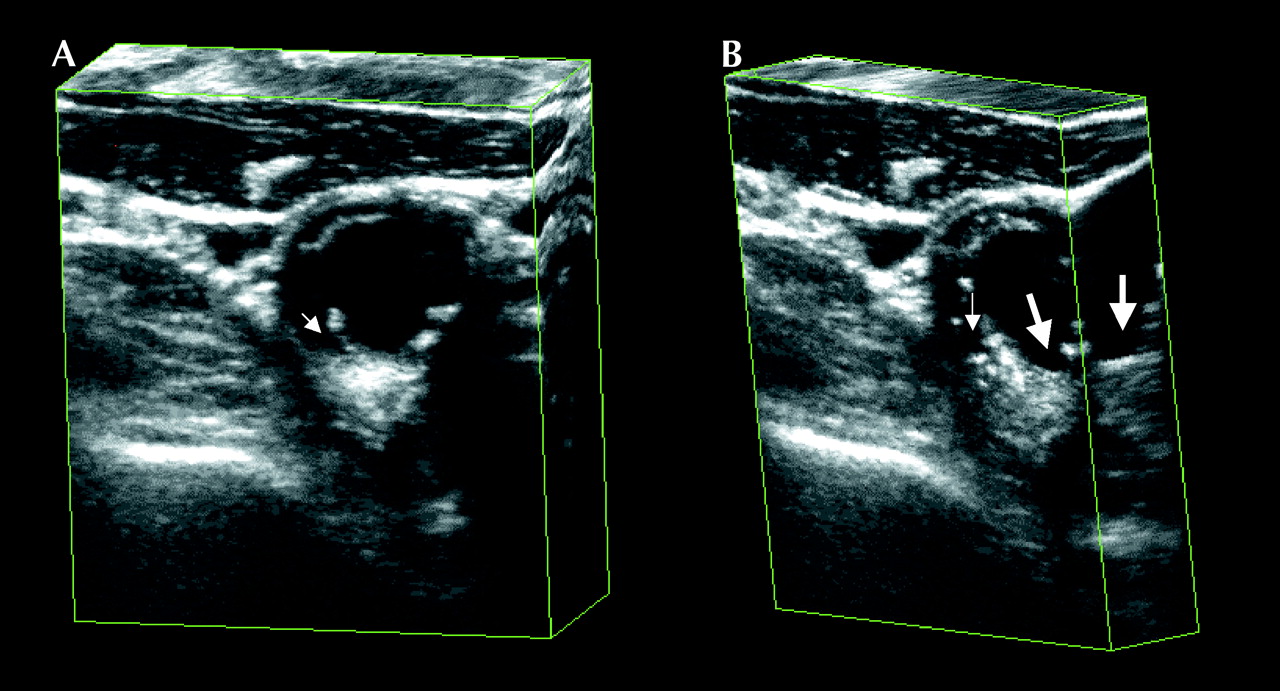

View larger version (60K):
[in this window]
[in a new window]
 
Figure 1. Photo: Courtesy: J. David Spence


Although endarterectomy is an effective treatment of symptomatic severe carotid stenosis,2 it is not routinely warranted in asymptomatic cases.3 Patients with severe symptomatic carotid stenosis have on average 6 microemboli per hour, which disappear with endarterectomy.4 The presence of microemboli, which has been associated with an 8-fold risk of subsequent cerebral events in both symptomatic and asymptomatic patients,5 may justify endarterectomy in asymptomatic patients.

J. David Spence Arturo Tamayo Maria DiCicco Stroke Prevention and Atherosclerosis Research Centre The John P. Robarts Research Institute London, Ont.

References

  1. Hackam DG, Peterson JC, Spence JD. What level of plasma homocyst(e)ine should be treated? Effects of vitamin therapy on progression of carotid atherosclerosis in patients with homocyst(e)ine levels above and below 14 micromol/L. Am J Hypertens 2000;13(1 pt 1):105-10.[Medline]
  2. Barnett HJM, Taylor DW, Eliasziw M, Fox AJ, Ferguson GG, Haynes RB, et al. Benefit of carotid endarterectomy in patients with symptomatic moderate or severe carotid stenosis. N Engl J Med 1998;339:1415-25.[Abstract/Free Full Text]
  3. Perry JR, Szalai JP, Norris JW, for the Canadian Stroke Consortium. Consensus against both endarterectomy and routine screening for asymptomatic carotid artery stenosis. Arch Neurol 1997; 54:25-8.[Abstract/Free Full Text]
  4. Van Zuilen EV, Moll FL, Vermeulen FE, Mauser HW, Van Gijn J, Ackerstaff RG. Detection of cerebral microemboli by means of transcranial Doppler monitoring before and after carotid endarterectomy. Stroke 1995;26(2):210-3.[Abstract/Free Full Text]
  5. Molloy J, Markus HS. Asymptomatic embolization predicts stroke and TIA risk in patients with carotid artery stenosis. Stroke 1999;30(7):1440-3.[Abstract/Free Full Text]


eLetters:

Read all eLetters

prevention of happening stroke
AHMED NABIL MANSOUR
CMAJ, 10 Apr 2003 [Full text]
Intraoperative strokes
J. David Spence
CMAJ, 14 Apr 2003 [Full text]

This Article
Right arrow Full Text (PDF)
Right arrow Submit a response
Right arrow View responses
Right arrow Alert me when this article is cited
Right arrow Alert me when eLetters are posted
Right arrow Alert me if a correction is posted
Services
Right arrow Email this article to a friend
Right arrow Similar articles in this journal
Right arrow Similar articles in PubMed
Right arrow Alert me to new issues of the journal
Right arrow Download to citation manager
Citing Articles
Right arrow Citing Articles via Google Scholar
Google Scholar
Right arrow Articles by Spence, J. D.
Right arrow Articles by DiCicco, M.
Right arrow Search for Related Content
PubMed
Right arrow PubMed Citation
Right arrow Articles by Spence, J. D.
Right arrow Articles by DiCicco, M.
Related Collections
Right arrow Vascular surgery
Right arrow Ischemic heart disease
Right arrow Stroke