


Epidemiology: Bullying occurs when one or more children repeatedly and intentionally intimidate, harass or physically harm another child who is perceived to be unable to defend himself or herself.1 It takes the form of threats, physical harm, rejection, name calling, teasing, rumours and the taking of personal belongings. It is a common problem worldwide, affecting about 1 in 5 school-aged children.1 Surveys have shown that the proportion of school-aged children who report being bullied is remarkably consistent between countries: Australia (17%), England (19%), Japan (15%), Norway (14%), Spain (17%) and the United States (16%).1 About 20% of children report being a bully.2
The prevalence of bullying appears to peak at age 7 (grade 2) and at ages 10 to 12 (grades 6 to 8),1,2 although there is little known about the prevalence of bullying among children too young to complete surveys. In general, boys are more likely than girls to be victims or perpetrators, or both.
The typical bully is indiscriminately aggressive toward teachers, parents, siblings and peers. He or she usually dislikes and has not adjusted to school, has poor impulse control, wishes to dominate, is physically and emotionally strong, craves social prestige and is insensitive to the feelings of others.3 Contrary to popular belief, bullies tend to have high self-esteem and report ease in making friends. Victims are more insecure than most children and react passively and anxiously to situations. They tend to be physically smaller and weaker and are often cautious, sensitive and quiet.1 Physicians should be aware that chronically ill children often fit this picture.
Clinical management: Physicians have 4 roles: identifying the problem, screening for psychiatric comorbidities, counselling the families and advocating for violence prevention. Children who are being bullied are more likely than those who are not to report having trouble sleeping (odds ratio [OR] 3.6), feeling unhappy or sad (OR 3.6), having stomach aches (OR 2.4), having headaches (OR 2.4) and wetting the bed (1.7).1 If a child's response to the general question “How are things going at school?” suggests that something is wrong, more specific questions should be asked:
· At recess, do you usually play with other children or by yourself?
· Have you ever been teased at school?
· What kinds of things do children tease you about?
· How long has this been going on?
· Have you told the teacher?
· Do you know of other children who are being teased?
Parents should be asked if they are worried that their child is having problems with other children.
When bullying is identified, physicians should screen for separation and generalized anxiety disorder, dysthymia and depression using DSM-IV criteria.4 Bullying is one of the criteria for conduct disorder. Referral to a psychiatrist or psychologist is warranted when a psychiatric comorbidity is suspected.
The goal of counselling is to raise the self-esteem of the child. Physicians can encourage parents to find an extracurricular activity in which the child excels or expresses an interest. It is imperative that parents and teachers meet so that supervision and sanctions can be arranged.1,2 The phrase “Walk, talk and squawk” can help bullied children respond to the bullying encounter: they should “walk” away from the bully (don't run), “talk” to the bully (look him or her in the eye) and “squawk” to the teacher (don't bottle it up).1
Prevention: According to one observer, “schools can be stages for dramas involving the interplay of the villains (bullies) and the antagonists (victims) sustained by the audience of bystanders.”5 Not only children, but also adults — teachers, lunchroom aides, playground supervisors, school secretaries — can assume a role in this triad. A pilot study of an elementary school intervention that focused on addressing the relationships between victims, bullies and observers rather than on individual pathology demonstrated a reduction in discipline-related referrals and an increase in academic achievement measures.5 The program had 4 components:
· Zero tolerance for behavioural disturbances such as bullying, victimization and standing by during bullying.
· A discipline plan for modelling appropriate behaviour.
· A physical education plan designed to teach self-control skills.
· A mentoring program for adults and children to help children avoid assuming one of the roles in the triad.
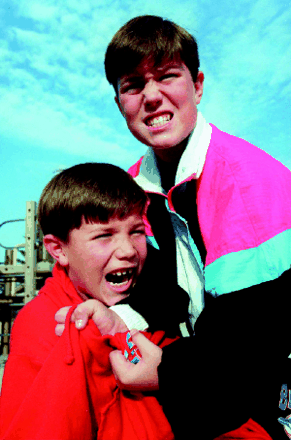
Figure. Bullying: remarkably consistent rates around the world Photo by: Canapress
In this issue
Article tools


Jump to section
Related Articles
Cited By...
More in this TOC Section
Similar Articles