

CMAJ • July 7, 2009; 181 (1-2). doi:10.1503/cmaj.081785.
© 2009 Canadian Medical Association or its licensors
All editorial matter in CMAJ represents the opinions of the authors and not necessarily those of the Canadian Medical Association.
This Article
Right arrow Figures Only
Right arrow Full Text
Right arrow Full Text (PDF)
Right arrow Résumé
Right arrow Abridged Version
Right arrow Submit a response
Right arrow View responses
Right arrow Alert me when this article is cited
Right arrow Alert me when eLetters are posted
Right arrow Alert me if a correction is posted
Right arrow Citation Map
Services
Right arrow Email this article to a friend
Right arrow Similar articles in this journal
Right arrow Similar articles in PubMed
Right arrow Alert me to new issues of the journal
Right arrow Download to citation manager
Google Scholar
Right arrow Articles by Mohaupt, M. G.
Right arrow Articles by Draeger, A.
PubMed
Right arrow PubMed Citation
Right arrow Articles by Mohaupt, M. G.
Right arrow Articles by Draeger, A.
Related Collections
Right arrow Drugs: cardiovascular system
Right arrow Adverse drug reactions
Right arrowRelated Articles


Research

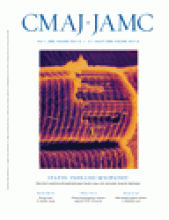
Association between statin-associated myopathy and skeletal muscle damage

Markus G. Mohaupt, MD, Richard H. Karas, MD PhD, Eduard B. Babiychuk, PhD, Verónica Sanchez-Freire, Katia Monastyrskaya, PhD, Lakshmanan Iyer, PhD, Hans Hoppeler, MD, Fabio Breil and Annette Draeger, MD

From the Department of Nephrology and Hypertension (Mohaupt), Inselspital, University of Bern, Bern, Switzerland; the Molecular Cardiology Research Institute and Division of Cardiology (Karas, Iyer), Tufts-New England Medical Center, Boston, USA; and the Institute of Anatomy (Babiychuk, Sanchez-Freire, Monastyrskaya, Hoppeler, Breil, Draeger), University of Bern, Bern, Switzerland

Correspondence to: Dr. Annette Draeger, Institute of Anatomy, University of Bern, Baltzerstr. 2, 3012 Bern Switzerland; fax 41 3163 13807; draeger{at}ana.unibe.ch

Background: Many patients taking statins often complain of muscle pain and weakness. The extent to which muscle pain reflects muscle injury is unknown.

Methods: We obtained biopsy samples from the vastus lateralis muscle of 83 patients. Of the 44 patients with clinically diagnosed statin-associated myopathy, 29 were currently taking a statin, and 15 had discontinued statin therapy before the biopsy (minimal duration of discontinuation 3 weeks). We also included 19 patients who were taking statins and had no myopathy, and 20 patients who had never taken statins and had no myopathy. We classified the muscles as injured if 2% or more of the muscle fibres in a biopsy sample showed damage. Using reverse transcriptase polymerase chain reaction, we evaluated the expression levels of candidate genes potentially related to myocyte injury.

Results: Muscle injury was observed in 25 (of 44) patients with myopathy and in 1 patient without myopathy. Only 1 patient with structural injury had a circulating level of creatine phosphokinase that was elevated more than 1950 U/L (10x the upper limit of normal). Expression of ryanodine receptor 3 was significantly upregulated in patients with biopsy evidence of structural damage (1.7, standard error of the mean 0.3).

Interpretation: Persistent myopathy in patients taking statins reflects structural muscle damage. A lack of elevated levels of circulating creatine phosphokinase does not rule out structural muscle injury. Upregulation of the expression of ryanodine receptor 3 is suggestive of an intracellular calcium leak.


Related Articles

Highlights
Can. Med. Assoc. J. 2009 181: 5. [Full Text] [PDF]

Dans ce numéro
Can. Med. Assoc. J. 2009 181: E1. [Full Text] [PDF]


eLetters:

Read all eLetters

fear mongering
David B Miller
CMAJ, 10 Jul 2009 [Full text]
puzzled at the lack of mention of Co Enzyme Q10 reduction by statins as likely key contributor.
nathan B Stein
CMAJ, 11 Aug 2009 [Full text]
Response to Dr. Stein
Annette Draeger
CMAJ, 8 Sep 2009 [Full text]
Response to Dr. Miller
Annette Draeger
CMAJ, 8 Sep 2009 [Full text]